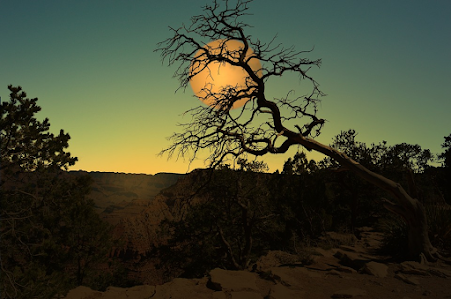
Le chant de la Préhistoire.


L’aube du monde.

Le chant de la Préhistoire.


    Chapitre I — Le chant de la lisière.

        Voix I — L'ombre de Lishan.

        Ainsi commence cette histoire :

    Avant les déserts, avant les savanes infinies, avant que la terre ne se fissure sous ses propres ardeurs, il y avait la Lisière : cette ligne invisible où la forêt rencontre la clairière, où l'ombre épouse la lumière, où le sol ferme succède aux racines altières.

    Pendant des millions d'années, avant Lucy, avant Ardi, avant même Toumaï, il y eut ceux de la Lisière. Ils ne laissèrent pas de tombes, pas de peintures, pas d'outils. Ils laissèrent leurs os quand le hasard les préserva. Et leurs os disent tous la même chose : ils marchaient debout.

    Un bipède marche au bord des arbres. Non pas pour une conquête mais pour une présence, non pas avec l'intelligence mais avec la posture.

    C'est là qu'il vit.

    Simplement lui-même, debout sur ses jambes, les yeux au niveau des premières branches.

    Son nom s'est perdu.

    Appelons le Lishan : celui qui regarde au-dessus. Ce nom n'a pas d'étymologie. Il est vide de sens réel et c'est peut-être mieux ainsi. Lishan n'appartient à aucun peuple connu, à aucune culture vivante. Il est antérieur à tout. Il mérite un nom qui ne renvoie à rien de familier.

    La définition "celui qui regarde au-dessus" est une invention poétique, destinée à résumer son essence : un bipède dressé, les yeux au niveau des premières branches, qui regarde l'horizon, symbole de sa destinée.

    Lishan n'est pas pressé. Il a tout le temps devant lui.

    Le matin, quand la brume monte du sous-bois, Lishan quitte son nid, un entrelacs de branches basses, à hauteur d'homme, où il a dormi recroquevillé. Il se dresse sur ses pieds, reste immobile un instant, écoutant le cri des oiseaux, le froissement des feuilles, le souffle lointain d'un prédateur.

    Puis il marche.

    Pas vite. Pas loin. Il longe la lisière, là où les fruits de la forêt rencontrent les racines de la clairière. Il croque des figues trouvées par terre, arrache des tubercules avec ses doigts agiles, brise une noix avec une pierre.

    Autour de lui, la forêt vibre. Des primates y vivent, plus agiles, plus poilus, plus criards. Ils restent dans l'ombre. Lishan les voit parfois, accrochés aux branches hautes, le regardant avec indifférence.

    Lui ne grimpe pas. Tout ce dont il a besoin est à hauteur de main, entre la terre et la première branche des arbres.

    Sa bipédie n'est pas une conquête. C'est une demeure.

The Echo Of The Ruins

 The Echo Of The Ruins.


Men who have reverted to a savage state after the great cataclysm discover an AI, Korg, in the ruins of a destroyed city. Following its instructions, they manage to partially repair it. Korg then guides them toward the people of the past, whom they finally find after many trials. Ruk, Aheya, Enmen, Tatiba, Limba, Akala, and Tahel are the members of the Shadow Clan who take part in this adventure. The author connects them to the Jarawa of the Andaman Islands in a call to protect their voice and culture for future generations.


The echo of the ruins

Winds and peaks !


Asma Mohamad

A Voice from Yemen.


    My name is Asma, a woman from a wounded Yemen, now in my forties. I am a teacher, gently guiding schoolchildren to read and write, a mother of eight, and a resident of Sana’a for the past seven years. I left my ancestral homeland—a place of ancient roots—for a new horizon that once brimmed with promises and hopes.
    
    Before my forced exile, I lived in my father's village, a rural settlement perched on a hill, encircled by dizzying mountains, within a millennia-old tribal society. Its rigid customs resisted change, shunning any openness to the outside world. My life grew far more challenging after the launch of the so-called “Decisive Storm” operation. Losing my income as a teacher only deepened my already precarious financial state.
    
    Desperate, with my savings drained and all my jewelry sold, I fled with my husband and our children from my native village. We sought to adapt to urban life in a sprawling city, where social differences collide in chaotic competition. I was thrust into an unforgiving world, transformed by war into a living hell. Amid relentless bombings, surrounded by corpses and rubble, I fought for my survival and that of my children. Yet I never lost my humanity. Clinging to traditional values, I remained stoic and dignified in the face of the material and moral desolation wrought by devastating chaos.
    
    My thoughts remain clear despite the religious fog that surrounds me. My life is a constant battle—against rigidity, poverty, the harsh conditions faced by women, daily burdens, and at times, abandonment. In the story that follows, I recount my long march to nowhere in a cruel, indifferent environment, much like the majestic mountains that encircle and loom over me with their towering heights. Readers will glimpse a world sealed off from prying eyes, existing on the margins of human hubs, yet pulsing with vitality—forged by the harshness of a rugged, inaccessible land that has imbued it with strength and stubborn resolve.
    
    Throughout my narrative, I occasionally delve into diverse topics that stray from the main storyline. These are necessary asides, woven in to shed light on a custom, a game, or a legend. I ask readers not to take offense at these detours. They are unrelated to my age as the story unfolds.

Read my book here.


La moisson


La moisson.


Quand j'étais petit garçon,
Il y a très très longtemps,
Je rêvais en suivant
Le fragile papillon
Qui volait insouciant
Sans penser au couchant.

عُباب


عُباب


عندما تُغْلَقُ الابواب

وتنسحب الأحباب

ويثور من البحر العُباب

ويصْعُبُ عن السؤال الجواب

أو عن اللحَن الصواب

فاعلم ان الافُقَ سراب

و أن النهار عتاب

و أن الليل عقاب.

م.ج

Et après ?


Et après ?


Tu es venu au monde
Et entamé la ronde
Des jours et des ans.
Et après ?
Tu as appris des noms
Et retenu des sons
Egarés dans le vent.
Et après ?
Tu as connu des gens
Elevé des enfants
Et changé de maison
Et après ?
Tu as marché longtemps
Parcourant ton chemin
Seulement
Pour en atteindre la fin !

Jeudi 05 mai 2022.

الشعر


الشعر

أيُّها الكَلامُ المُلَوَّنُ بالصْوتِ وَبِالمَعــاني
يَنْبَعُ مِنَ القَلْبِ الحَزينِ كَالسِّحْرِ مِنَ البَيانِ
يُعَبِّـرُ عَنِ المَشاعِـرِ إذا بَعُدَتْ عَنِ اللّسانِ
فَيُحَوِّلُها إلى لَحْـنٍ إلى سَجْـعٍ إلى أغانـي
وَ يُبَدِّلُها إلى دُرٍّ إلى لُجَيْـنٍ إلى جُمــان.

أذبت الشعر لك من شوق لألوان
من حزن لألحان من يأس لريحان
وما أتاني منك إلا ظلام بأشجاني
وصبابة بأحضاني وماء بأجفاني.

02.01.2022